Home › Common Problems › Garage Floor Cracks and Settling
Garage Floor Cracks and Settling
in Wilmington, NC
A garage floor takes a lot of abuse, but most cracks are not from use. They are from the soil underneath failing. In Wilmington, garage slabs are often poured on fill dirt that was not compacted properly, especially in homes built in the 1990s and early 2000s in fast-growing areas like Porters Neck. When that fill settles or gets wet, the slab has no support and it cracks.
Wilmington Concrete Repair Pros helps Wilmington, NC homeowners fix garage floor cracks and settling — call for a free inspection.
Quick Answer
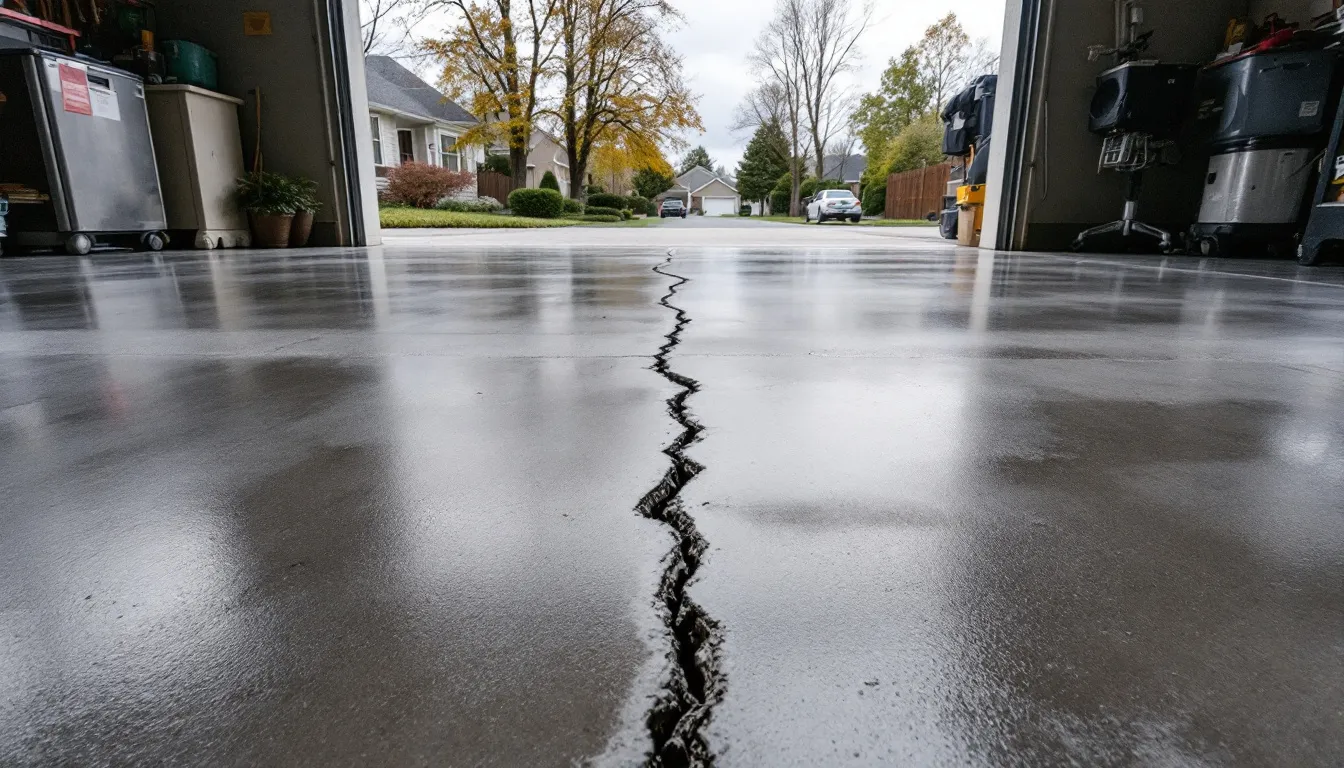
Garage floor cracks in Wilmington usually happen because the soil underneath was not compacted well before the slab was poured, or because water has been washing out the fill over time. Small hairline cracks can be sealed to keep water out. Cracks that are wide, offset, or growing mean the base underneath has a real problem and needs to be addressed. If the floor is also sloping toward the back of the garage, that is a sign the soil underneath has moved.
Telltale Signs
Warning Signs to Watch For
- Cracks running across the garage floor from wall to wall
- One section of the floor sitting lower than the rest
- A gap opening between the garage floor and the wall
- Cracks wider at one end than the other
- Water coming in through a crack after it rains
- A hollow sound when you knock on the floor near a crack
Root Causes
What Causes Garage Floor Cracks and Settling?
Fill Soil Settling
Many Wilmington garage slabs were poured directly on fill dirt that was brought in to level the lot. Fill that was not compacted in layers will continue settling for years under the slab. As the soil drops, the slab loses support and cracks, often in the center of the floor.
The Fix
Slab Lifting with Void Fill
A grout or foam is injected through holes in the slab to fill the settled area underneath and bring the floor back to level. The holes are patched after and the floor is ready to use quickly.
Water Intrusion from Poor Grading
If the yard outside the garage slopes toward the building instead of away from it, rainwater runs along the foundation and finds its way under the slab. That constant moisture washes out fine soil particles from the fill, leaving voids under the floor. Wilmington gets enough rain in a single storm to make this happen fast.
The Fix
Exterior Grading Correction and Crack Repair
The ground outside needs to be regraded to direct water away from the garage before the floor is fixed. If the slab damage is limited to cracks, those can be filled after the drainage issue is resolved.
Slab Poured Too Thin
A garage floor should be at least four inches thick. Slabs poured at three inches or less flex when you drive on them and crack under the weight of a vehicle. This was not uncommon in budget construction in Wilmington through the 1990s. A thin slab on loose soil fails even faster.
The Fix
Slab Replacement at Correct Thickness
The thin slab is removed, the base is compacted properly, and a new slab is poured at the right thickness. Patching a slab that is fundamentally too thin is a short-term fix.
Self-Diagnosis
Which Cause Applies to You?
Check the signs you're observing to narrow down the likely root cause before your inspection.
| What You're Seeing | Fill Soil Settling | Water Intrusion from Poor Grading | Slab Poured Too Thin |
|---|---|---|---|
| Crack in the center of the floor with hollow sound nearby | |||
| Water appearing along crack after rain, no other water source nearby | |||
| Multiple cracks across a floor less than 15 years old | |||
| Floor slopes visibly toward the back of the garage | |||
| Gap opened between floor slab and the wall | |||
| Cracks wider in the center than at the walls |
Free Quote
Get a free quote in Wilmington
No obligation — tell us what's going on and we'll text you back shortly.
Other Problems
Services That Fix This
Garage Floor Cracks and Settling Near You
Also Helpful